Professionals remove pet stains by targeting the chemical components of urine that bind to carpet fibres. This process involves locating hidden contamination with specialised lighting, breaking down uric acid crystals with powerful cleaning agents, and physically extracting the entire mixture from deep within the carpet and underlay.
Standard surface cleaning cannot resolve the issue because urine penetrates beyond the visible carpet pile. The bottom line is that permanent removal requires dissolving the urine crystals and flushing them from every affected layer of the flooring.
Understanding the Chemistry: Why Pet Stains Require Professional Techniques
Pet urine contains uric acid that forms non-soluble salt crystals, which bond to fibers and reactivate with moisture to release recurring odors long after the initial spill. While consumer-grade cleaners often only mask surface smells, professional techniques utilize concentrated enzymatic or oxidizing agents to chemically break down these crystals at a molecular level. This advanced approach ensures the complete destruction of bacteria and salts within the carpet backing and underlay, providing a permanent solution that household detergents cannot achieve.
The Professional Process and Essential Equipment
The professional removal process is highly systematic, addressing contamination from the surface pile down to the sub-floor. This restoration requires specialized diagnostic and mechanical equipment unavailable for domestic use to ensure the complete elimination of both the visible stain and the underlying odor source.
The Step-by-Step Technical Method
The professional technical method for pet urine removal utilizes a high-precision, multi-stage protocol to ensure complete neutralization of contaminants across all carpet layers. This systematic approach combines advanced chemical engineering with industrial-grade machinery to address the unique molecular structure of pet stains.
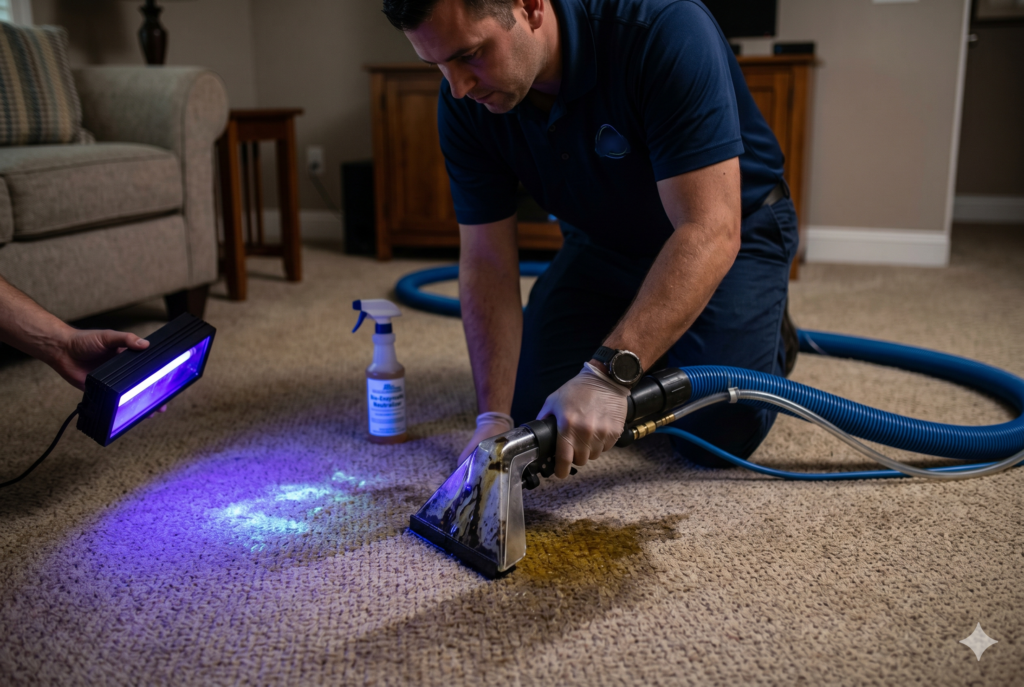
- Advanced Contamination Discovery: Technicians utilize industrial 365nm UV blacklights to reveal phosphorus and proteins, ensuring that every affected area (including invisible or aged spots) is identified for treatment.
- Molecular Chemical Neutralization: Professional-grade enzymatic and oxidizing agents are applied to break the chemical bonds of uric acid crystals, destroying odors at the source rather than masking them with fragrances.
- High-Pressure Hot Water Extraction: Truck-mounted extractors inject high-temperature water deep into the fibers to dissolve suspended contaminants, providing significantly more suction and heat than portable rental units.
- Sub-Surface Extraction Technology: Specialized tools create a vacuum seal to pull liquid directly from the underlay and sub-floor, flushing out contaminants that standard cleaning wands cannot reach to prevent “wick-back” odors.
By integrating specialized equipment with concentrated chemical solutions, this method achieves a level of hygiene and odor elimination that consumer-grade products cannot replicate. This rigorous technical standard ensures the long-term preservation of your flooring and the total removal of deep-seated bio-contaminants.
Specialised Treatments for Different Carpet Fibres
Carpet fiber type dictates the specific chemical formulation and cleaning method required for safe restoration. While resilient synthetics like nylon and polyester withstand standard hot water extraction, natural fibers like wool are highly absorbent and sensitive to high alkalinity, requiring pH-balanced solutions to prevent permanent damage or color loss.
Qualified technicians identify these materials to precisely calibrate water temperature and chemical potency, ensuring effective cleaning without compromising the carpet’s structural integrity.
Secure Your Precision Assessment
A proper assessment requires a physical inspection to determine the extent of the contamination within the carpet’s lower layers. Our technicians use specialised tools to analyse the underlay and sub-floor. This diagnostic step ensures that the quote we provide accurately reflects the work needed to solve the problem permanently. Click the button below to schedule an on-site inspection.
FAQs
How do professionals get old pet urine out of carpet?
Professionals remove old urine by first rehydrating the uric acid crystals with a specialised pre-treatment solution. This solution breaks down the salt crystals that have bonded to the carpet fibres over time. Following this chemical breakdown, they use a sub-surface extraction tool combined with a hot water rinse to flush the urine, bacteria, and cleaning solution from the carpet, the underlay, and sometimes the sub-floor itself.
What is the best professional-grade chemical for pet odors?
Enzymatic cleaners and oxidising agents are the two primary types of professional-grade solutions for pet odours. Enzymatic cleaners use specific proteins to biologically break down uric acid into carbon dioxide and ammonia. Oxidising agents work through a chemical reaction that destroys the stain’s molecular structure, making them highly effective on visible stains and often faster acting. The best choice depends on the carpet fibre and the severity of the contamination.
Does steam cleaning effectively remove pet urine smell or set it?
Using high heat from steam cleaning on an untreated urine stain can permanently set the stain and bond the proteins to the carpet fibres, making the odour much harder to remove. Professional hot water extraction is different; technicians apply chemical pre-treatments to break down the urine crystals before rinsing with hot water. This sequence ensures that the stain is neutralised before the heat is applied.
What is sub-surface extraction and why is it necessary for pet accidents?
Sub-surface extraction is a technique used to remove liquid that has soaked into the carpet underlay and sub-floor. It uses a specialised tool that creates a powerful vacuum seal, allowing the technician to flush large volumes of water through all layers of the carpet and pull the contamination out. It is necessary because pet urine often penetrates far beyond the surface fibres, and without extracting it from the padding, the odour and stain will reappear as the carpet dries.